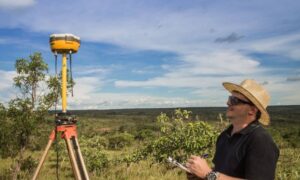

If you’ve worked a job, you know the pattern: the morning starts calm, then the wind ramps up by lunch. Yet you still need clean deliverables—maps, surfaces, and measurements you can defend. That’s why aerial surveying needs more than a good drone. It needs a smart plan and proof that the data holds up.
This week, one more factor matters. NOAA’s Space Weather Prediction Center noted that some space-weather products/services could face disruptions through December 17, 2025 due to network changes. Even if you never read a space-weather update, GNSS workflows can still run into “off” days. So, on windy days, you don’t send it and hope. Instead, you verify what you deliver.
Wind doesn’t just shake the drone—it bends the data
Wind pushes a drone off its ideal path. It also changes camera angle in tiny ways from photo to photo. Because of that, stitching software has a harder time matching features cleanly. Next, the model can warp in spots that look fine at first glance.
Plus, wind makes the site move. Grass ripples. Tree limbs sway. Plastic wraps flap. Those moving textures confuse image matching, especially on wide-open lots where the wind hits with no break. Still, wind alone doesn’t ruin a project. Weak planning does.
The hidden risk: GNSS confidence changes day to day
Most clients think GPS works like a light switch: on means accurate. In reality, GNSS depends on satellites, correction streams, and the tools you use to judge conditions. Therefore, a “normal” day and a “noisy” day can look the same to a non-surveyor.
That’s why the NOAA notice works as a real-world hook. When space-weather products/services face disruptions, teams lose one more signal they use to plan around risk. Also, space weather can raise positioning noise at times. So, instead of trusting a single nice-looking reading, pros check repeatability and add redundancy.
What survey-grade accuracy means
Survey-grade accuracy means your map lines up with ground truth when you test it. It also means you can show the test results, not just point to a nice-looking image. A pretty orthomosaic can still hide a small shift, and that shift can throw off real decisions on site. That’s why some crews call it survey-grade aerial mapping because the value isn’t the picture, it’s the verified accuracy behind it.
Start with control, because control keeps you honest
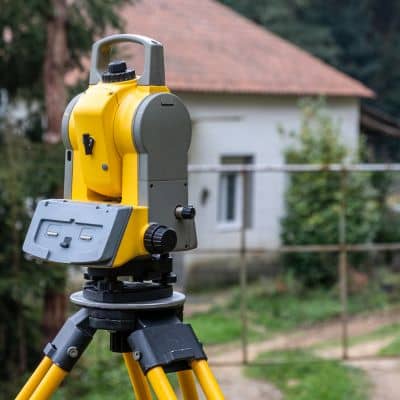
On windy days, control acts like a seatbelt. It keeps the dataset tied to reality.
First, set or observe ground control points you trust. Next, fly and process the imagery. Then, test the finished model with separate check points. Don’t use the same points for both jobs. Otherwise, you end up grading your own homework.
In OKC, this matters because schedules move fast. Builders want pad grades, curb lines, and quantities yesterday. However, speed without control often leads to rework. Control lets you move fast while staying right.
Plan the flight like the wind will fight you
A windy-day flight needs discipline. You don’t chase speed. You chase consistency.
Start by flying more than one direction. If you fly only one set of lines, the wind can push the whole dataset in a similar way. Instead, add a second set from another direction. That extra geometry helps the model lock in.
Next, give the site more overlap. More overlap gives the software more chances to match features correctly. Then, slow down when gusts hit. Motion blur kills detail, while a steady pace protects sharpness.
Finally, treat edges like priority zones. Warping often shows up near edges first. Therefore, plan extra coverage on corners, pad limits, road ties, and sharp breaklines—the exact places clients care about most. Also, when you can, fly earlier. In OKC, wind often builds later in the day.
When GNSS feels noisy, tighten QC before you commit
When people say “GPS gets weird,” they usually mean the numbers stop agreeing. You can’t fix that with confidence alone. Instead, you fix it with checks.
Do a quick go/no-go scan before you set control and fly. Confirm the coordinate system and vertical reference. Check the health/status of the services and tools you rely on when applicable. Then look for signs of noise: repeat shots that don’t settle, unusual scatter, or unstable quality metrics.
During field work, repeat key control observations and compare them. Tie to know control when you can. Add independent check points that you never use as control. After that, write short notes about what you saw and what you changed. Those notes protect you when questions come later.
Prove accuracy after processing, not during the sales call
After processing, the truth shows up. So, don’t stop at “the map looks right.”
Run checkpoints and report results in plain language. If you hit the tolerance you promised, ship it. If you miss, fix the workflow and re-check. Sometimes you add more control. Other times you adjust flight geometry or re-fly a small area.
Wind leaves clues in the data. You might see stretching near edges or soft detail on fine features like curb lines. When you spot those signs early, you can correct them fast. That saves time, money, and trust.
What clients should ask before hiring an aerial surveying provider
Clients don’t need survey jargon. They just need a few strong questions. Ask how the team will establish ground control, how many independent checkpoints they will run, and whether they will share a simple accuracy summary with the deliverables. Also ask what they do when GNSS confidence drops on a given day.
Good teams answer clearly. They also explain how they adapt during weeks when external signals—like NOAA’s notice about space-weather product/service disruptions—suggest extra uncertainty.
The bottom line
Windy days don’t have to wreck your schedule or your accuracy. When you plan the flight for wind, anchor the work with control, and prove results with checkpoints, you can still deliver survey-grade accuracy. And when the wider GNSS world throws a warning, you don’t panic. Instead, you verify, document, and deliver a result your client can trust.